Wednesday, September 20, 2017

IN THE SPOTLIGHT NuEar Heaing Center

We are please to announce our newest advertiser in the 
SPOTLIGHT Senior Services & Living Options Resource Guide


NuEar Hearing Center was founded on two simple truths- that hearing is a vital sense which plays a significant role in your quality of life and that hearing loss affects everyone uniquely. That’s why we work to solve hearing problems one individual at a time.
From the moment you walk in our front doors in Tucson, to the moment you walk out- We guarantee precise care and satisfaction. We understand that the journey to better hearing begins with a partnership with a hearing health specialist that understands the difficulties hearing loss places on one’s life. We have the knowledge and technology to guide you towards a hearing aid that will fit your unique lifestyle. We do all of this with the utmost care and respect because we know that Tucson is a place worth hearing.
Conveniently located off of East Grant Road, we are proud to serve our Tucson community in their journey to better hearing.

Russell Broadhead, BS, HIS

Hearing Instrument Specialist
License #HADR9827

Hello Tucson!! My name is Russell Broadhead and I am the Hearing Instrument Specialist of Nuear Hearing Center of Tucson. I am honored to take part in the journey to better hearing of the people of this beautiful city!
For the past four years I have merged my love of art and technology by providing hearing health care for the people of Chicago and am thrilled to now do the same for the people of Tucson. As a hearing practitioner, my goal is to, quite frankly, change people’s lives. Better hearing can take people from isolation and return them to life, fully engaged with family and friends.
One of the best experience of my career was seeing the change in my Father in Law when he was fitted with hearing aids. They truly changed his life.
At her weekly bridge game, a past patient was quiet and aloof because she just couldn’t hear her friends. Now she is engaged and thriving. The smile on her face when she recounted her experience was heartwarming.
Another client had struggled at work because he couldn’t hear his supervisors and coworkers. This caused him great anxiety and affected his work performance. Now he is back ‘in the game’ and experiencing great personal and professional successes thanks to his customized hearing plan.
My core values are Honesty, Integrity, and Family. I graduated from Utah State University with a Bachelor of Science degree. I am an Eagle Scout and served as a missionary for the Church of Jesus Christ of Latter-day Saints in Zimbabwe, Africa. My beautiful wife Jenny and I are the parents of five fantastic daughters and an amazing son.
Visit us online today @ www.tucsonNuEar.com

Tuesday, September 12, 2017

How To Care For Health Care Costs in Retirement


How much do you figure you'll pay for health care expenses after you retire? You're probably underestimating.
A married couple, both age 65, will fork over an estimated $275,000 over their lifetime on medical costs, according to Fidelity Investment's "2017 Retiree Health Care Cost Estimate." That includes Medicare premiums, co-payments, deductibles and out-of-pocket expenses for prescription drugs. 
However, it's likely that this same couple will pay a lot more than $275,000 because Fidelity's estimate doesn't include items such eye exams and glasses, hearing aids, dental care and long-term care. And if you retire before age 65, the number will be significantly higher.
Medical expenses represent one item in retirees' budgets that can increase significantly when transitioning from your career job into retirement. According to the U.S. Bureau of Labor Statistics, employers on average subsidize 80 percent of the cost of health care premiums for their active employees and more than two-thirds of the costs for family coverage. 


But these subsidies typically go away when you retire. As a result, you'll usually end up paying for the full cost of medical insurance premiums if you retire before age 65, when you're eligible for Medicare. After that, the federal government subsidizes about three-fourths of the cost of Medicare Part B, although you'll still pay substantial deductibles and co-payments.
One erroneous conclusion that some people might make after reading about the Fidelity study's results is that they need to have the full $275,000 amount set aside when they retire, to be dedicated exclusively to future medical expenses. While that might be great if you can swing it, most people don't have that luxury, and fortunately you don't need to do that. 
You can pay for much of your medical costs with your regular retirement income, such as your Social Security benefits, employer pensions if you have one, money you make working in retirement and your withdrawals from savings.
By making smart choices with Medicare and supplemental insurance, you can turn large, unpredictable expenses into regular monthly premium payments that you can then factor into your ongoing retirement budget. Because Medicare has substantial deductibles and co-payments that can amount to thousands of dollars each year, financial advisers highly recommend that you buy supplemental medical insurance in one of two ways:
1.      Purchase a "Medigap" plan that pays for part or all of Medicare's deductibles and co-payments, combined with a separate insurance plan that covers the cost of prescription drugs under Medicare Part D.
2.     Purchase a Medicare Advantage plan (MA) that typically integrates inpatient care, outpatient care and the cost of prescription drugs, and usually covers much of Medicare's out-of-pocket costs.
You can also save for medical expenses with a Health Savings Account (HSA), in which contributions have a unique triple tax advantage:
·         They're deducted from your taxable income when they're made
·         Investment earnings aren't taxed
·         Any amounts you withdraw for qualified medical expenses aren't included in your taxable income
Because of the triple tax advantages, HSAs are like a super-IRA, and you should save as much as possible in these plans while you're working.
Qualified medical expenses that can be paid from an HSA include:
·         Medical, dental, prescription drug and vision expenses, including any deductibles and co-payments
·         Premiums paid after age 65 for Medicare or for your employer's retiree medical plan (but not for Medicare supplement plans)
·         COBRA premiums
·         Long-term care services
·         Premiums for qualified long-term care insurance
You'll also want to plan for vision and dental expenses when you retire because Medicare doesn't cover these costs. Some MA or Medigap plans might help with these costs, so you'll want to ask about that when you're shopping for these plans. Another smart tip: Take full advantage of your employer-provided medical plan's vision and dental benefits before you walk out the door of your career job.
Long-term care is the wild card in your retirement planning. A lengthy stay in an assisted living facility or nursing home can quickly drain your retirement savings, even if you have substantial savings in an HSA, 401(k) or IRA. Ideally, you want to develop a thoughtful strategy to protect yourself and your family against potentially ruinous long-term care expenses, including some combination of:
·         Buying long-term care insurance
·         Holding home equity in reserve
·         Taking out a reverse mortgage line of credit and holding it in reserve for long-term care
·         Maintaining a separate investment account for long-term care, including an HSA
·         Buying a qualified longevity annuity contract (QLAC) that starts a lifetime income at an advanced age, such as age 80 or 85.
When you consider your potential costs for health care, you might be convinced it's a smart idea to work longer, which is a very reasonable -- and wise -- reaction to these threats. Working longer can not only extend subsidized medical care coverage from your employer, but it can also allow your Social Security benefits and savings to grow as long as possible.
You have a lot to consider when it comes to your retirement planning. But if you start now, you'll be prepared when the time comes to leave the work force entirely.
Visit us online today @ www.novareverse.com


Wednesday, August 30, 2017

Reverse Mortgage For Dummies Cheat Sheet


UNDERSTAND REVERSE MORTGAGES


People tend to shy away from the very idea of reverse mortgages, in part because of their former bad rap, and in part because of all the scary terminology. When someone starts spouting off about how you can “utilize the equity in your home on deferred payments with a conversion mortgage,” chances are pretty good you’re going to tune it out.
Reverse mortgages pay you to continue living in your home. You can think of your home as the Bank of You: You’re borrowing money that you would have earned had you sold your house. You can then use the money for whatever you want. Anything your heart desires (and your wallet can handle) is yours for the taking, whether it’s a vacation in Switzerland, moving your master bedroom to the first floor, or sending yourself to college!
The concept is kind of abstract if you’ve been paying a lender for the past 30 years or so, and it may be difficult to grasp at first. Take a look at the quick reference points below:
  • You’re a homeowner who owes little or nothing on your home. You decide you need more money to live the lifestyle you want, but your biggest asset is your home and you certainly don’t want to sell it to get the money you need.
  • A reverse mortgage lender figures out how much it can lend you based on your home value, your age, and interest rates, and loans you some percentage of the money you would have gotten if you’d decided to sell your home.
  • You still own your home and continue to live in it, but now you’re getting payments from the lender, so your cash flow problem is solved.
  • You pay the loan back (with interest) only when you don’t live in the house full time anymore, usually due to moving out or death.
  • You never owe more than your home is worth, no matter how much you’ve accumulated in debt.
  • You keep any leftover equity after the sale of the house; if you owe the lender $67,000 and your home sells for $200,000, you put the difference in your pocket and walk away smiling.
A reverse mortgage is sometimes called a deferred payment loan, and for a very good reason. Instead of paying off the home loan as you borrow money, the payments are put off (deferred). This is why reverse mortgages can be such a good choice for seniors; when you’re on a fixed income or living off of your savings, it can help to have some extra cash in hand to supplement.
REMEMBER!   Because payment is deferred, you are spending the equity in your home, rather than earning it (as you would with a traditional forward mortgage). Since equity is an intangible value, you never feel the effects of the equity going down, but you sure feel the money flowing steadily into your checking account.

KNOW WHAT A REVERSE MORTGAGE ISN’T

A reverse mortgage can be a lot of things: a way to make ends meet, a nice chunk of change for a rainy day, a fabulous dream vacation, or a remodeled kitchen. But there’s one thing it’s definitely not — free money. There’s no free lunch here.
WARNING!  While reverse mortgages allow homeowners (who are at least 62 years old) to borrow against their home’s equity and still maintain ownership of the home, your loan will need to be paid back, just like any other loan (whether it’s due when you move or upon your death).
There are fees involved that can include payments to the originator, the appraiser, postage fees, recording fees . . . the list goes on and on. (These are the same sort of fees you paid for the mortgage that bought you the home you live in now.) You also have to pay interest on your loan, which is generally right around the interest rates on traditional mortgages.
REMEMBER!  You only pay interest on what you borrow, so any money that you don’t use from your pool of reverse mortgage funds isn’t charged.
WARNING!  A reverse mortgage is also not a direct value-to-dollar loan. You are loaned a percentage of your home value, based on age, interest rates, and area. Don’t expect the full value of your home, or you’ll be very disappointed. Before you make plans to spend money you don’t yet have, go online and click on the reverse mortgage calculator. This very cool tool from the National Reverse Mortgage Lenders Association gives you an estimate of what you may be able to borrow.
Lastly, a reverse mortgage is not an all-encompassing loan that’s right for everyone. Just because you qualify by being a 62-year-old homeowner doesn’t mean you’re an ideal candidate. To find out whether or not a reverse mortgage is right for you, here are a few of the basic questions you can ask yourself:
  • Are you at least 62 and own your own home?
  • Do you plan to be in your home for at least 5 years?
  • If you’re getting the loan to purchase or pay off something specific, have you looked into other options for financing those expenses?
  • Are you comfortable with the terms of the loan?
The more of these questions you can answer “yes” to, the more ready you are for a reverse mortgage.

QUICK REVERSE MORTGAGE PLANNING TIPS

Before you make up your mind about pursuing a reverse mortgage, take a minute to make sure you’re starting out on the right foot. Having a strong foundation will make your loan process much easier, both for you and for the professionals involved.
For the best planning, follow these tips:
  • Know all you can about reverse mortgages before you walk into your counselor’s or originator’s office. It pays to be well-informed, and you’ll be more relaxed when you know what to expect.
  • Make sure you qualify for the loan (you’re at least 62 and own your home). When in doubt, just go for it. It never hurts to go talk to the counselor, and if you don’t qualify the counselor may know of another program that can solve your financial situation.
  • Get to know the loan options. Read about each one, and consider which works best for you based on your home value, county, and age. Get your family’s input as well, but always do what feels right to you. After all, it’s your loan.
  • Plan your repayment carefully. Don’t leave this important step to the last minute or unresolved for your heirs. Lay out a plan and be sure to record it in your will. Talk to your family about their future responsibilities.
  • When you go to your counselor meeting, take along a friend or family member who can help you take notes, ask additional questions, and weigh in afterward. Sometimes it helps to have someone there to bounce options off of, or just hold your hand while your counselor explains your choices.
  • Get your money’s worth out of your originator. Ask as many questions as you can think of, call if anything comes up before or after the loan closes, and feel free to ask for help along the way. You’re paying for their services — make it count.
  • Before your appraiser arrives, spruce up your house (within reason). Give everything a good scrubbing and fix the little things that are broken. Try to look at your home from an appraiser’s point of view and be realistic in your expectations of your home’s value.
  • If you’re an adult child of someone who’s thinking of getting a reverse mortgage, find out all you can about the loan, and be a part of the process if your parent allows it.
  • If you’re a baby boomer, start planning now! Pay off as much of your current mortgage as you can afford, and get your home ready to be a retirement paradise.
  • Most importantly, if you ever have questions or don’t feel comfortable with some part of the loan, stop! Ask questions and get them resolved before you move on.

Visit us online today!  www.novareserve.com 

Friday, August 25, 2017

Home Equity Loan Vs. Reverse Mortgage Loan


Considering Tapping Your Home Equity? Compare Your Options First


Rising costs and expenses coupled with a fixed income can be a significant challenge as you age.
If savings, Social Security, and modest retirement income is proving insufficient, you may be considering the role your home could play in meeting daily living expenses or planning for a secure financial future. When it comes to your home, selling to downsize is one option. You might also consider finding someone to share your home.
There are also financial products and tools that can help unlock the equity you’ve built up over the years. Each option has its pros and cons, and they vary in feature options.
Earlier this year, NCOA asked senior homeowners about their understanding of home equity release products. The homeowners told us that, despite their home equity representing a majority of their overall retirement assets (from 60-80%), few understood home equity products, and most would be reluctant to use one. The research also revealed some negative bias against a reverse mortgage line of credit, based on the product name, and preconceived notions of the product.
Here’s a comparison of the most common home equity release products:

Home Equity Product Comparisons

Home Equity Lines of Credit (HELOCs)Reverse Mortgage Line of Credit (Home Equity Conversion Mortgages or HECM)Home Equity Loans
Borrowers have access to funds for a specified time periodBorrowers have access to funds for no specified time periodBorrowers have access to a specified lump sum up front for a specified time period
Must make minimum monthly paymentsNo minimum payments requiredMust make specific set monthly payments
Lender can freeze or reduce the line of creditLender cannot freeze or reduce the line of creditLender cannot freeze or reduce the loan amount
Home subject to foreclosure if minimum payments, taxes, or insurance not paid, or borrower does not keep the home in good repairHome subject to foreclosure if taxes or insurance not paid, borrower does not keep the home in good repair, or does not live in the home as primary residenceHome subject to foreclosure if minimum payments, taxes, or insurance not paid, or borrower does not keep the home in good repair
Loan balance must be paid back in full, even if borrower owes more than home is worthBorrowers or heirs never pay back more than the home’s fair market value when soldLoan balance must be paid in full, based on a fixed interest rate on a specific schedule
Fees and costs to obtain the HELOC can include closing costsFees and costs to obtain the HECM can include closing costs, counseling fee, and mortgage insurance premiumsFees and costs to obtain the Home Equity Loan can include closing costs
If you’re looking for tools to unlock cash from your home to plan for the future, or to meet your current needs, here are a few tips to get started:
  • Download NCOA’s free booklet, Use Your Home to Stay at Home© (available in both English and Spanish).
  • Contact a Department of Housing and Urban Development (HUD) approved housing counselor, or other trusted financial advisor, with questions or to discuss options.
  • Shop around and compare quotes to assure the best value for the solution you’re seeking.
  • Take a free and confidential BenefitsCheckUp® to find out if you’re eligible for relevant property tax relief or other public benefit programs.
Don’t wait for an emergency. Plan now, so you don’t have to make your choice in a crisis. Getting educated about the many options available for accessing your home’s equity can help secure your future and maximize your resources for a long, healthy life!
Visit us online today @ www.novareverse.com

Friday, August 18, 2017

How Does A Reverse Mortgage Work?


(CBS) — It’s a tax free source of income, but only 2 percent of seniors take advantage of it.  View CBS 2 Cost Cutter Dorothy Tucker shows who could benefit the most from a reverse mortgage.  http://chicago.cbslocal.com/2017/08/11/how-does-a-reverse-mortgage-work/#.WZHDX2gi01M.facebook
“It gave my dad the sense of independence,” says financial expert Terry Savage.
She says a reverse mortgage can help people like her dad live comfortably in their own homes until they die.
It’s like using your home equity as another retirement savings account.
“It comes out as a tax-free withdrawal for you to live on,” Savage says.
A reverse mortgage works best for someone who owes little or nothing on the original mortgage and plans to live in the home for more than five years.
“Do your research, shop around and talk with a federally approved housing counselor,” advises Jason Adler with the Federal Trade Commission (the FTC has information here).
He says fees, interest rates and restrictions vary. Plus, you still have to pay property taxes & insurance.
“Failure to do those sorts of things can make the loan immediately due and could eventually lead to foreclosure,” warns Adler.
Here’s something else to consider: When you move out of your home or die the balance due on the reverse mortgage loan will be paid through the sale of the house.
If the home sells for more than you owe, you or your estate will get money back. But if you’ve borrowed more than the value of the home, the lender keeps it.
“They can never charge your heirs more than the house is worth, you simply turn over the property to the reverse-mortgage lender,” says Savage.
You have to be 62 to take out a reverse mortgage.
Savage suggests taking a monthly check, rather than a lump sum payment, which you might use up too fast.
Visit us online @ www.novareverse.com

Wednesday, July 12, 2017

Financing Longevity


IN 1965 ANDRÉ-FRANÇOIS RAFFRAY, a 47-year-old lawyer in southern France, made the deal of a lifetime. Charmed by an apartment in Arles, he persuaded the widow living there that if he paid her 2,500 francs (then about $500) a month until she died, she would leave it to him in her will. Since she was already 90, it seemed like a safe bet. Thirty years later Mr Raffray was dead and the widow, Jeanne Louise Calment, was still going strong. When she eventually passed away at 122, having become the world’s oldest person, the Raffray family had paid her more than twice the value of the house.

Underestimating how long someone will live can be costly, as overgenerous governments and indebted private pension schemes have been discovering. They are struggling to meet promises made in easier times. Public pensions are still the main source of income for the over-65s across the OECD, but there are big differences between countries (see chart). In both America and Britain public provision replaces around 40% of previous earnings, but in some European countries it can be 80% or more. Where it makes up a big share of total pension income, as in Italy, Portugal and Greece, a shrinking workforce will increasingly struggle to finance a bulging group of pensioners.

Private pension schemes, which supplement state provision, have been shifting from defined-benefit plans, where workers are promised a fixed amount of income in retirement, to defined-contribution plans, where workers themselves take on the risk. Such schemes are good for employers but tricky for individuals, who become personally responsible for ensuring they do not outlive their savings. The new stage of life now emerging between work and old age adds a further complication. To accommodate these changes, the financial industry needs an overhaul.

First, it has to update the rigid three-stage life-cycle model on which most of its products are based. Second, it needs to resolve two opposite but equally troubling problems: undersaving during working life and oversaving during retirement. The first puts pressure on public provision, the second leads to underconsumption as cash is left under the mattress. Third, a more creative approach is needed to the range of assets that pensioners can draw on, including their homes, which have so far played little part in provision for old age.
“In a multi-stage life, the idea of hitting a cliff-edge retirement at 65 and then living off an annuity is outdated,” says Alistair Byrne, from State Street Global Advisors, a money manager. His clients, many of whom intend to work past normal retirement age, are asking for more flexibility to get at their savings at a younger age. They also want a secure income for the last phase of life. “It’s not at all obvious that the traditional pension industry, which still sees life as a three-stage event, will survive this transition,” says Andrew Scott of the London Business School.


Nothing in the kitty

Many people simply do not save enough. Roughly 40% of Americans approach retirement with no savings at all in widely used retirement accounts such as IRAs or 401(k)s. In Britain 20% of women and 12% of men between 55 and 65 have no retirement savings, according to Aegon. Yet with the demise of defined-benefit schemes, the increase in the retirement age and the steady rise in life expectancy, most of today’s workers will need to save more than their parents did. Some of them do not earn enough to put money aside, but for many the problem is in the mind: they consistently underestimate how long they will live and overestimate how long their money will last. As more people become self-employed, getting them to save for their old age becomes ever more important.
One solution is to allow retirement funds to be used more flexibly, which may encourage people to save more. But nudges are unlikely to be enough. “People need a push,” says Myungki Cho, from Samsung Life’s Retirement Research Centre in Seoul. Some countries, such as Denmark and the Netherlands, provide such a push by making enrolment in pension schemes more or less mandatory. Short of that, auto-enrolment, recently introduced in Britain, and auto-escalation (increasing contributions over time) can also make a difference.

Often people just need the confidence that they really can afford to spend a little more on themselves.

At the same time many pensioners spend less than they can afford, which creates its own problems. Ronald Lee and Andrew Mason have found that in most rich countries the elderly are net savers. Since they cannot be sure how long they will live and what their state of health will be, and have no way of predicting inflation, interest rates and markets, some caution is clearly in order. But Chip Castille, from BlackRock, an asset manager, thinks oversaving is often unintentional. “It would be an extraordinary coincidence if you saved exactly enough for retirement,” he says.

This gets to the heart of why some economists are pessimistic about greying societies. In a phase when older people should be spending freely, many are accumulating wealth, says David Sinclair, of the ILC UK. He thinks the greater pension freedoms granted in Britain in 2015 are more likely to lead to frugality rather than spending sprees.

Such “accidental” oversaving will increase in a world of defined-contribution plans, predicts Tony Webb, an economist at the New School, in New York City. Given a choice, people will assemble their own kitties rather than buy annuities that provide an agreed lifetime income in exchange for a lump sum. If they die young, the money will be a windfall for their heirs. Similarly, since money locked up in homes is difficult to get at during the owner’s lifetime, much of this too will be passed on, Mr Webb adds. Raising inheritance-tax rates could make a difference, but better insurance is equally important. This dormant wealth, which is often neither invested nor spent, is stopping many of the younger old from realising their full economic potential. “Often people just need the confidence that we’ve run the numbers and that they really can afford to make that donation to a charity, or spend a little more on themselves,” says Kai Stinchcombe, from True Link, a financial-advice firm for pensioners.
Take care
Depending on where people live, how much they earn and whether they have family willing to care for them, one of the greatest financial risks of ageing can be end-of-life care expenditure. A 50-year-old American has a better-than-even chance of ending up in a nursing home, estimate Michael Hurd and colleagues from RAND, a research organisation in America. In Britain an official review in 2011 of long-term care reckoned that a quarter of older people in Britain needed very little care towards the end of life but 10% faced care costs in excess of £100,000.

Most countries will need to find a mix of public and private provision to pay for long-term care costs. A well-functioning insurance market should be an important part of this, but care insurance has mostly failed to take off. American providers who piled in too enthusiastically in the 1990s got burnt when customers needed more care than expected, and are still haunted by the experience. Low rates of return on bonds have not helped.
Every country has its own peculiarities, but four common factors help explain the market failures. First, the future of public care is uncertain. Second, despite or because of this, many people think they do not need insurance because the state or their family will look after them. Third, the market is subject to “adverse selection”—the likelihood that insurance will appeal only to those most at risk of needing care. And fourth, care costs are unpredictable and could spin out of control in the future. As a result, insurers either avoid the care market altogether, or charge exorbitant premiums and add lots of restrictions.

As with any big risk, pools need to be large to make protection products work. The easiest way to achieve this is to make insurance compulsory, as in Germany. One alternative is auto-enrolment in a public-private scheme with an opt-out, a method with which Singapore is experimenting. At a minimum, some government intervention—such as providing a backstop for the most catastrophic risks—seems to be required for the market to establish itself. But perhaps the biggest problem is that government policies chop and change far too often.
Insurers could help, not least by offering more hybrid products such as life insurance with the option of an advance on the payout if customers need care, or annuities that pay a lower-than-usual income but convert to a higher-than-usual rate if pre-agreed care levels become necessary. And there is a need for clearer guarantees against unexpected premium hikes. Most importantly, though, insurers will need to persuade people to enroll long before they are likely to require any care.

By far the most common reason for someone needing long-term care is that they are suffering from Alzheimer’s or some other form of dementia. Globally around 47m people have dementia. Without a medical breakthrough this number could grow to 132m by 2050, according to the World Alzheimer’s Report. One study found that people suffering from dementia accounted for four-fifths of all those in care homes worldwide.

In the absence of other options, for many people the ultimate insurance is their home, though few homeowners see it that way. In the rich world much of the wealth of lower and middle-income households is tucked away in bricks and mortar. With house prices soaring in many countries, releasing some of this equity could greatly benefit asset-rich but cash-poor pensioners, as well as the wider economy.

The most obvious tool for this is a reverse mortgage, which lets homeowners exchange some of their home’s equity for a lump sum or a stream of income in retirement. But it is not widely used. In America fewer than 49,000 reverse mortgages were sold last year, most of them provided by only about ten banks. Mis-selling scandals in the early days now seem to have been resolved, says Jamie Hopkins, of the American College of Financial Services, but people find such mortgages scary and worry that they might lose their home. Because of the lack of competition, the products also remain expensive. Mainstream financiers could help expand the market.

In the meantime, entrepreneurial empty-nesters have found another way to sweat their assets: Airbnb. The over-60s are the fastest-growing group of hosts on the home-sharing site and receive the highest ratings. Almost half of older hosts in Europe say the additional income helps them stay in their home.
The longer that people live, the more varied their life cycle will become. Workers will take breaks to look after children or go back to school; pensioners will take up a new job or start a business. Financial providers need to recognize these changing needs and cater for them. That includes helping to fund technology that could vastly improve the final stage of life.

Visit us online today @ www.novareverse.com


Thursday, June 29, 2017

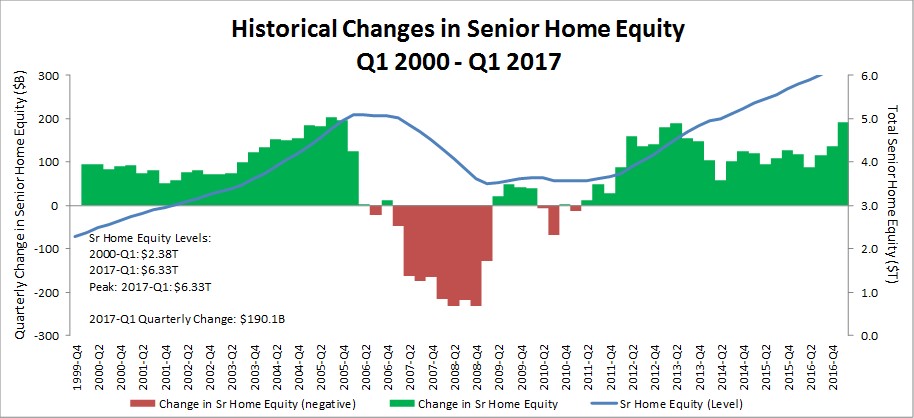
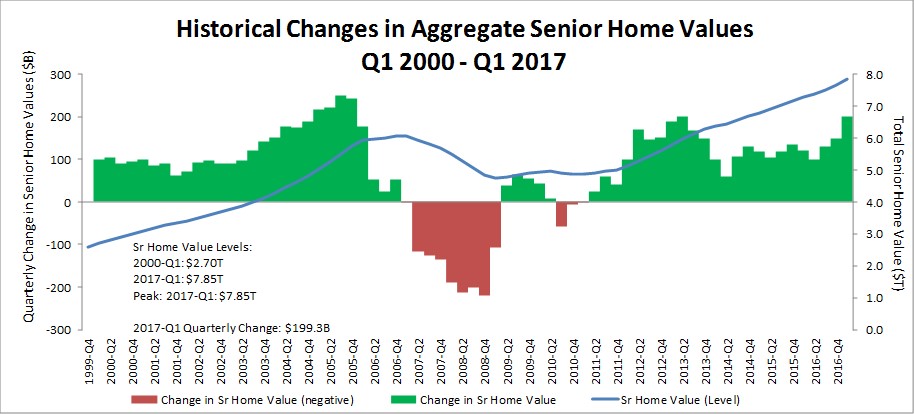
Raising Home Values Boost Senior Home Equity to $6.3 Trillion in Q1 2017


June 22, 2017


Housing Wealth for Homeowners 62 and Older Grew 3.1% in First Quarter
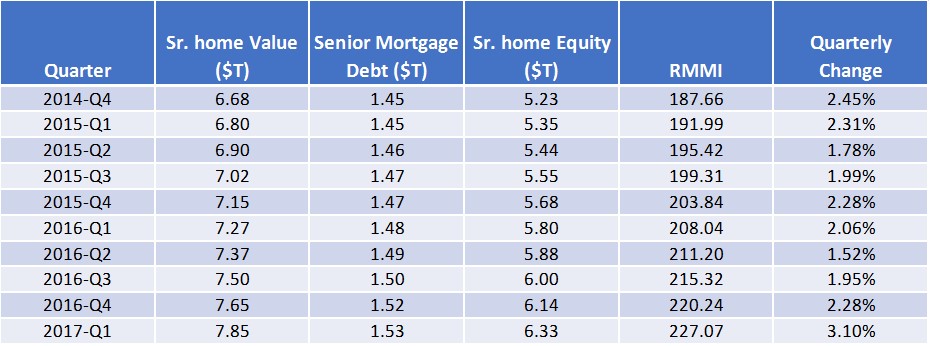
WASHINGTON (June 22, 2017) – The National Reverse Mortgage Lenders Association reports today that homeowners age 62 and older saw their home equity increase by a combined 3.1 percent to $6.3 trillion in the first quarter of 2017 from $6.13 trillion in Q4 2016.
According to the NRMLA/RiskSpan Reverse Mortgage Market Index, the growth in housing wealth for retirement-aged homeowners was driven by an estimated 2.6 percent, or $199.3 billion, improvement in senior home values, and offset by a 0.6 percent increase of senior-held mortgage debt that equaled $9.2 billion. The RMMI, a quarterly measurement of home equity held by older homeowners, rose to 227.07 in Q1 2017, another all-time high since the index was first published in 2000.
“Older adults who want to stay in their own homes as they age, and we know a majority do, may find that the house that was perfect for raising a family lacks the features to support aging in place. But, instead of moving out, various modifications, such as stairless entryways and wider bathroom doorframes, can be made to accommodate new mobility and accessibility needs,” said NRMLA President and CEO Peter Bell. “The housing wealth our seniors have built up in their homes over the years, their home equity, can be used to update the family house into a space for living comfortably and independently for years to come.”
Aging in an Age Friendly Home: Managing the Costs of Home Modifications with Home Equity,” a recorded NRMLA sponsored webinar for the American Society on Aging, features presentations by Louis Tenenbaum, one of the nation’s leading authorities on aging in place; Todd Brickhouse, an expert on mobility modifications; and Craig Barnes, a Certified Reverse Mortgage Professional who explains how homeowners 62 and older can tap home equity with a reverse mortgage to pay for projects.
To help explain home equity and its uses, NRMLA recently released its “Learn About Home Equity” infographic, and the three-part article, “An Introduction to Housing Wealth: What is home equity and how can it be used?,” which are available on NRMLA’s consumer education website www.reversemortgage.org/HomeEquity.
Prepared by RiskSpan, Inc.
Data Sources: American Community Survey, Census, FHFA, Federal Reserve


Prepared by RiskSpan, Inc.
Data Sources: American Community Survey, Census, FHFA, Federal Reserve Z.1 Release

About Reverse MortgagesReverse mortgages are available to homeowners age 62 and older with significant home equity. They are a versatile financial tool seniors can use to borrow against the equity in their home without having to make monthly principal or interest payments as with a traditional “forward” mortgage or a home equity loan. Under a reverse mortgage, funds are advanced to the borrower and interest accrues, but the outstanding balance is not due until the last borrower leaves the home, sells or passes away.
To date, 1,035,486 households have utilized an FHA-insured reverse mortgage to help meet their financial needs. For more information, please visitwww.ReverseMortgage.org
About the National Reverse Mortgage Lenders AssociationThe National Reverse Mortgage Lenders Association (NRMLA) is the national voice for the industry and represents the lenders, loan servicers, and housing counseling agencies responsible for more than 90 percent of reverse mortgage transactions in the United States. All NRMLA member companies commit themselves to a Code of Ethics & Professional Responsibility. Learn more at www.nrmlaonline.org 
About RiskSpan, Inc.RiskSpan offers end-to-end solutions for data management, risk management analytics, and visualization on a highly secure, fast, and fully scalable platform that has earned the trust of the industry’s largest firms. Combining the strength of subject matter experts, quantitative analysts, and technologists, the RiskSpan platform integrates a range of data-sets–including both structured and unstructured–and off-the-shelf analytical tools to provide you with powerful insights and a competitive advantage. Learn more at www.riskspan.com.
Visit us online today @ www.novareverse.com