Wednesday, July 12, 2017

Financing Longevity


IN 1965 ANDRÉ-FRANÇOIS RAFFRAY, a 47-year-old lawyer in southern France, made the deal of a lifetime. Charmed by an apartment in Arles, he persuaded the widow living there that if he paid her 2,500 francs (then about $500) a month until she died, she would leave it to him in her will. Since she was already 90, it seemed like a safe bet. Thirty years later Mr Raffray was dead and the widow, Jeanne Louise Calment, was still going strong. When she eventually passed away at 122, having become the world’s oldest person, the Raffray family had paid her more than twice the value of the house.

Underestimating how long someone will live can be costly, as overgenerous governments and indebted private pension schemes have been discovering. They are struggling to meet promises made in easier times. Public pensions are still the main source of income for the over-65s across the OECD, but there are big differences between countries (see chart). In both America and Britain public provision replaces around 40% of previous earnings, but in some European countries it can be 80% or more. Where it makes up a big share of total pension income, as in Italy, Portugal and Greece, a shrinking workforce will increasingly struggle to finance a bulging group of pensioners.

Private pension schemes, which supplement state provision, have been shifting from defined-benefit plans, where workers are promised a fixed amount of income in retirement, to defined-contribution plans, where workers themselves take on the risk. Such schemes are good for employers but tricky for individuals, who become personally responsible for ensuring they do not outlive their savings. The new stage of life now emerging between work and old age adds a further complication. To accommodate these changes, the financial industry needs an overhaul.

First, it has to update the rigid three-stage life-cycle model on which most of its products are based. Second, it needs to resolve two opposite but equally troubling problems: undersaving during working life and oversaving during retirement. The first puts pressure on public provision, the second leads to underconsumption as cash is left under the mattress. Third, a more creative approach is needed to the range of assets that pensioners can draw on, including their homes, which have so far played little part in provision for old age.
“In a multi-stage life, the idea of hitting a cliff-edge retirement at 65 and then living off an annuity is outdated,” says Alistair Byrne, from State Street Global Advisors, a money manager. His clients, many of whom intend to work past normal retirement age, are asking for more flexibility to get at their savings at a younger age. They also want a secure income for the last phase of life. “It’s not at all obvious that the traditional pension industry, which still sees life as a three-stage event, will survive this transition,” says Andrew Scott of the London Business School.


Nothing in the kitty

Many people simply do not save enough. Roughly 40% of Americans approach retirement with no savings at all in widely used retirement accounts such as IRAs or 401(k)s. In Britain 20% of women and 12% of men between 55 and 65 have no retirement savings, according to Aegon. Yet with the demise of defined-benefit schemes, the increase in the retirement age and the steady rise in life expectancy, most of today’s workers will need to save more than their parents did. Some of them do not earn enough to put money aside, but for many the problem is in the mind: they consistently underestimate how long they will live and overestimate how long their money will last. As more people become self-employed, getting them to save for their old age becomes ever more important.
One solution is to allow retirement funds to be used more flexibly, which may encourage people to save more. But nudges are unlikely to be enough. “People need a push,” says Myungki Cho, from Samsung Life’s Retirement Research Centre in Seoul. Some countries, such as Denmark and the Netherlands, provide such a push by making enrolment in pension schemes more or less mandatory. Short of that, auto-enrolment, recently introduced in Britain, and auto-escalation (increasing contributions over time) can also make a difference.

Often people just need the confidence that they really can afford to spend a little more on themselves.

At the same time many pensioners spend less than they can afford, which creates its own problems. Ronald Lee and Andrew Mason have found that in most rich countries the elderly are net savers. Since they cannot be sure how long they will live and what their state of health will be, and have no way of predicting inflation, interest rates and markets, some caution is clearly in order. But Chip Castille, from BlackRock, an asset manager, thinks oversaving is often unintentional. “It would be an extraordinary coincidence if you saved exactly enough for retirement,” he says.

This gets to the heart of why some economists are pessimistic about greying societies. In a phase when older people should be spending freely, many are accumulating wealth, says David Sinclair, of the ILC UK. He thinks the greater pension freedoms granted in Britain in 2015 are more likely to lead to frugality rather than spending sprees.

Such “accidental” oversaving will increase in a world of defined-contribution plans, predicts Tony Webb, an economist at the New School, in New York City. Given a choice, people will assemble their own kitties rather than buy annuities that provide an agreed lifetime income in exchange for a lump sum. If they die young, the money will be a windfall for their heirs. Similarly, since money locked up in homes is difficult to get at during the owner’s lifetime, much of this too will be passed on, Mr Webb adds. Raising inheritance-tax rates could make a difference, but better insurance is equally important. This dormant wealth, which is often neither invested nor spent, is stopping many of the younger old from realising their full economic potential. “Often people just need the confidence that we’ve run the numbers and that they really can afford to make that donation to a charity, or spend a little more on themselves,” says Kai Stinchcombe, from True Link, a financial-advice firm for pensioners.
Take care
Depending on where people live, how much they earn and whether they have family willing to care for them, one of the greatest financial risks of ageing can be end-of-life care expenditure. A 50-year-old American has a better-than-even chance of ending up in a nursing home, estimate Michael Hurd and colleagues from RAND, a research organisation in America. In Britain an official review in 2011 of long-term care reckoned that a quarter of older people in Britain needed very little care towards the end of life but 10% faced care costs in excess of £100,000.

Most countries will need to find a mix of public and private provision to pay for long-term care costs. A well-functioning insurance market should be an important part of this, but care insurance has mostly failed to take off. American providers who piled in too enthusiastically in the 1990s got burnt when customers needed more care than expected, and are still haunted by the experience. Low rates of return on bonds have not helped.
Every country has its own peculiarities, but four common factors help explain the market failures. First, the future of public care is uncertain. Second, despite or because of this, many people think they do not need insurance because the state or their family will look after them. Third, the market is subject to “adverse selection”—the likelihood that insurance will appeal only to those most at risk of needing care. And fourth, care costs are unpredictable and could spin out of control in the future. As a result, insurers either avoid the care market altogether, or charge exorbitant premiums and add lots of restrictions.

As with any big risk, pools need to be large to make protection products work. The easiest way to achieve this is to make insurance compulsory, as in Germany. One alternative is auto-enrolment in a public-private scheme with an opt-out, a method with which Singapore is experimenting. At a minimum, some government intervention—such as providing a backstop for the most catastrophic risks—seems to be required for the market to establish itself. But perhaps the biggest problem is that government policies chop and change far too often.
Insurers could help, not least by offering more hybrid products such as life insurance with the option of an advance on the payout if customers need care, or annuities that pay a lower-than-usual income but convert to a higher-than-usual rate if pre-agreed care levels become necessary. And there is a need for clearer guarantees against unexpected premium hikes. Most importantly, though, insurers will need to persuade people to enroll long before they are likely to require any care.

By far the most common reason for someone needing long-term care is that they are suffering from Alzheimer’s or some other form of dementia. Globally around 47m people have dementia. Without a medical breakthrough this number could grow to 132m by 2050, according to the World Alzheimer’s Report. One study found that people suffering from dementia accounted for four-fifths of all those in care homes worldwide.

In the absence of other options, for many people the ultimate insurance is their home, though few homeowners see it that way. In the rich world much of the wealth of lower and middle-income households is tucked away in bricks and mortar. With house prices soaring in many countries, releasing some of this equity could greatly benefit asset-rich but cash-poor pensioners, as well as the wider economy.

The most obvious tool for this is a reverse mortgage, which lets homeowners exchange some of their home’s equity for a lump sum or a stream of income in retirement. But it is not widely used. In America fewer than 49,000 reverse mortgages were sold last year, most of them provided by only about ten banks. Mis-selling scandals in the early days now seem to have been resolved, says Jamie Hopkins, of the American College of Financial Services, but people find such mortgages scary and worry that they might lose their home. Because of the lack of competition, the products also remain expensive. Mainstream financiers could help expand the market.

In the meantime, entrepreneurial empty-nesters have found another way to sweat their assets: Airbnb. The over-60s are the fastest-growing group of hosts on the home-sharing site and receive the highest ratings. Almost half of older hosts in Europe say the additional income helps them stay in their home.
The longer that people live, the more varied their life cycle will become. Workers will take breaks to look after children or go back to school; pensioners will take up a new job or start a business. Financial providers need to recognize these changing needs and cater for them. That includes helping to fund technology that could vastly improve the final stage of life.

Visit us online today @ www.novareverse.com


Thursday, June 29, 2017

Raising Home Values Boost Senior Home Equity to $6.3 Trillion in Q1 2017


June 22, 2017


Housing Wealth for Homeowners 62 and Older Grew 3.1% in First Quarter
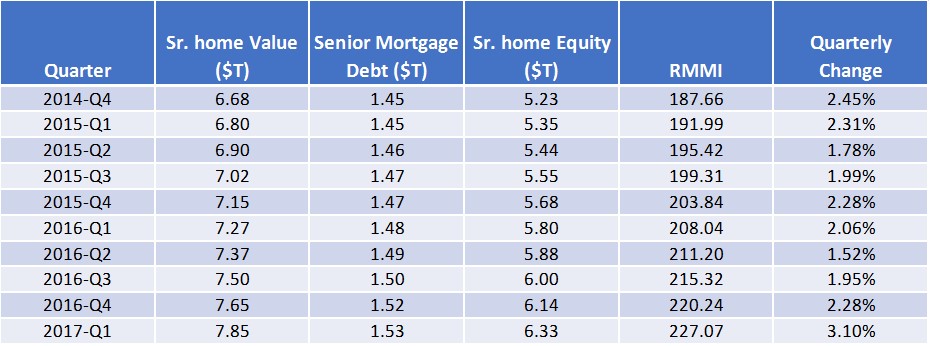
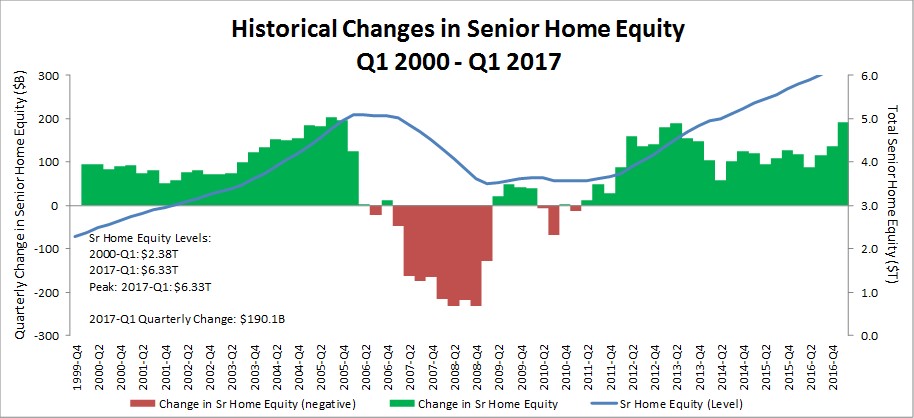
WASHINGTON (June 22, 2017) – The National Reverse Mortgage Lenders Association reports today that homeowners age 62 and older saw their home equity increase by a combined 3.1 percent to $6.3 trillion in the first quarter of 2017 from $6.13 trillion in Q4 2016.
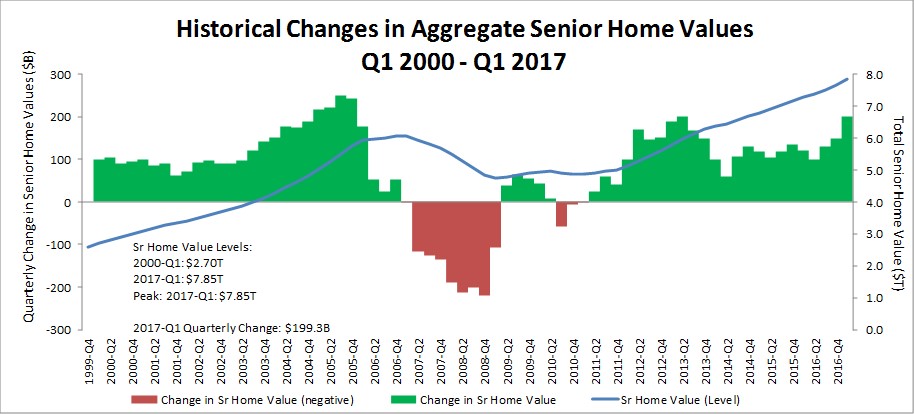
According to the NRMLA/RiskSpan Reverse Mortgage Market Index, the growth in housing wealth for retirement-aged homeowners was driven by an estimated 2.6 percent, or $199.3 billion, improvement in senior home values, and offset by a 0.6 percent increase of senior-held mortgage debt that equaled $9.2 billion. The RMMI, a quarterly measurement of home equity held by older homeowners, rose to 227.07 in Q1 2017, another all-time high since the index was first published in 2000.
“Older adults who want to stay in their own homes as they age, and we know a majority do, may find that the house that was perfect for raising a family lacks the features to support aging in place. But, instead of moving out, various modifications, such as stairless entryways and wider bathroom doorframes, can be made to accommodate new mobility and accessibility needs,” said NRMLA President and CEO Peter Bell. “The housing wealth our seniors have built up in their homes over the years, their home equity, can be used to update the family house into a space for living comfortably and independently for years to come.”
Aging in an Age Friendly Home: Managing the Costs of Home Modifications with Home Equity,” a recorded NRMLA sponsored webinar for the American Society on Aging, features presentations by Louis Tenenbaum, one of the nation’s leading authorities on aging in place; Todd Brickhouse, an expert on mobility modifications; and Craig Barnes, a Certified Reverse Mortgage Professional who explains how homeowners 62 and older can tap home equity with a reverse mortgage to pay for projects.
To help explain home equity and its uses, NRMLA recently released its “Learn About Home Equity” infographic, and the three-part article, “An Introduction to Housing Wealth: What is home equity and how can it be used?,” which are available on NRMLA’s consumer education website www.reversemortgage.org/HomeEquity.
Prepared by RiskSpan, Inc.
Data Sources: American Community Survey, Census, FHFA, Federal Reserve


Prepared by RiskSpan, Inc.
Data Sources: American Community Survey, Census, FHFA, Federal Reserve Z.1 Release

About Reverse MortgagesReverse mortgages are available to homeowners age 62 and older with significant home equity. They are a versatile financial tool seniors can use to borrow against the equity in their home without having to make monthly principal or interest payments as with a traditional “forward” mortgage or a home equity loan. Under a reverse mortgage, funds are advanced to the borrower and interest accrues, but the outstanding balance is not due until the last borrower leaves the home, sells or passes away.
To date, 1,035,486 households have utilized an FHA-insured reverse mortgage to help meet their financial needs. For more information, please visitwww.ReverseMortgage.org
About the National Reverse Mortgage Lenders AssociationThe National Reverse Mortgage Lenders Association (NRMLA) is the national voice for the industry and represents the lenders, loan servicers, and housing counseling agencies responsible for more than 90 percent of reverse mortgage transactions in the United States. All NRMLA member companies commit themselves to a Code of Ethics & Professional Responsibility. Learn more at www.nrmlaonline.org 
About RiskSpan, Inc.RiskSpan offers end-to-end solutions for data management, risk management analytics, and visualization on a highly secure, fast, and fully scalable platform that has earned the trust of the industry’s largest firms. Combining the strength of subject matter experts, quantitative analysts, and technologists, the RiskSpan platform integrates a range of data-sets–including both structured and unstructured–and off-the-shelf analytical tools to provide you with powerful insights and a competitive advantage. Learn more at www.riskspan.com.
Visit us online today @ www.novareverse.com 

Wednesday, June 21, 2017

9 Essential Ways to Fund Retirement


9 Essential Ways to Fund Retirement

Even if you're behind on your retirement savings, there are various ways you can save for and fund retirement. Here are nine ways you can do both.


Social Security: Benefits are based on the highest 35 years of earnings. Every year a person delays claiming, benefits increase by approximately 7% (delaying from age 62 to age 70 results in a cumulative 76% increase). Couples would be wise to explore claiming strategies.


Pension: If eligible to receive a pension, speak to human resources about potential benefits, including if there is an option for a survivor benefit.


401(k) Plans (and similar workplace retirement plans): Up to $18,000 per year plus an additional $6,000 catch-up contribution for those age 50 or older can be contributed annually. If an employer match is available, try to contribute enough to maximize it if unable to save the maximum $18,000/$24,000.


IRAs: Dollars contributed to a traditional individual retirement account are tax-deductible. Mandatory withdrawals (RMDs) start at age 70 1/2, and all withdrawals are taxed at ordinary income rates.


Roth IRA's:  Contributions are made with after-tax dollars, but withdrawals are not taxed. Plus, no withdrawals are required for the account owner.


Health Savings Accounts: Like Roth IRAs, contributions are made with after-tax dollars, but withdrawals are not required for the account owner. Withdrawals are tax-free if used to pay for qualified medical expenses.


Housing: Downsizing and/or moving to a less-expensive area frees up cash and reduces expenses. The first $500,000 in capital gains on the sale of a married couple's home is not taxed as long as basic requirements are met. If you plan to stay in your existing house, a reverse mortgage can provide a stream of income.


Work Longer: Postponing retirement gives you more years to save, creates more time for your savings to grow and reduces the amount of time your savings have to last. Once in retirement, working part-time can provide supplemental income even if it means that more of your Social Security benefits are taxed.


Taxable Accounts: Money saved in bank accounts and traditional brokerage accounts counts as part of your cumulative wealth. Even if you have it mentally budgeted to pay for other things, these savings should not be ignored when it comes to funding retirement expenses.


Visit us online today @ www.novareverse.com 
Wednesday, June 7, 2017

Want Financial Security? Home Equity and Retirement Accounts are Key


It might seem obvious, even simplistic. But having home equity and retirement accounts are key to most families’ financial assets and — by extension — retirement security.
According to new research from the nonpartisan Employee Benefit Research Institute (EBRI), home equity and retirement accounts — 401(k)-type plans and IRAs — account for nearly all the assets that many families have to depend on in retirement outside of Social Security and traditional pension plans.
In its research, EBRI looked at the level of assets held by families with a working family head ages 25‒64 in so-called “individual account” retirement plans and compared those levels with all of their financial assets, as well as equity in their homes.
And what EBRI discovered was this: Families with individual account retirement plans and home equity will have something to draw from for retirement expenses, outside of Social Security, while those families without retirement plans won’t.

So, what might those saving for or living in retirement do or not do given EBRI’s findings?
For those saving for retirement. Sterling Raskie, a certified financial planner with Blankenship Financial Planning recommends that you start saving for retirement as early as possible using either an employer-sponsored plan such as a 401(k) or an individual plan such as an IRA.
And don’t worry if you’re not socking away as much as possible in your retirement accounts when you’re in your late 20s, early 30s. The EBRI research seems to suggest that you’ll build your nest egg over time. In fact, in the EBRI research, assets in retirement accounts represented 47.1% of all financial assets held in families with a working head of household ages 55-64.
Buy a house. Consider buying a house if you don’t own one, paying down your mortgage as fast as possible. Why? “Home equity is a very important asset for American retirees, and so it is important to think about how to make best use of home equity in retirement planning,” says Wade Pfau, professor of retirement income at The American College of Financial Services and author of Reverse Mortgages: How to use Reverse Mortgages to Secure Your Retirement.
Others also say home equity is an important part of a sound retirement plan. “Social Security and home equity are major pieces of the retirement puzzle,” says Randy Bruns, a private wealth adviser with HighPoint Planning Partners.“But for most individuals, the primary focus is all too often how much has been saved in their retirement accounts.If you ask me, that’s one of the biggest flaws I see in retirement planning. “
Raskie also says homeowners who pay down their mortgage faster can boost the chances of a better retirement outlook. Paying down the principal on your mortgage will increase the value of your home equity. “This can be considered a guaranteed rate of return with no risk,” he says.
Also, homeowners might evaluate what effect upgrading homes over the years might have on the value of their home equity. “Understand the impact upgrading homes during a career or taking out a mortgage just before or in retirement can have on long-term financial goals,” says Raskie.
For those in retirement. Retirees who are concerned about cash flow – about having enough income to cover their expenses – might consider downsizing their homes if they don't need as much space, says Raksie.
There are tax benefits to selling one’s house worth noting as well. According to the IRS, if you sell your home at a significant profit (gain), some or all of that gain could be taxable. However, in most cases, if the home you sold counts as your main home, the first $250,000 of gain isn’t taxable—$500,000 if you are married and filing jointly. Read Publication 523, Selling Your Home.  
“Additionally, those with high amounts of home equity can consider using a reverse mortgage to insulate their retirement portfolio withdrawals and decrease the chances of portfolio failure,” says Raskie.
Randy Bruns, a private wealth adviser with HighPoint Planning Partners, also says a reverse

mortgage is an important tool in the retirement-income toolbox. “Reverse mortgages have

become a critical component of retirement planning,” he says. “A reverse mortgage line of

credit can greatly reduce sequence of return risk by providing timely 
access to cash so you
won’t have to sell investments until after markets have recovered. The hope is that a reverse mortgage line of credit can act as a standby source of liquidity in the kinds of instances that would otherwise lead to financial ruin for your portfolio.”
Consider if and when debt useful. For those saving for and living in retirement, Raskie recommends “carefully considering if and when any debt is necessary.” The EBRI research seems to suggest that those who prioritized savings versus debt, are in a much better position for retirement.
Consider a balanced approach to retirement planning. “The risks you’ll face in retirement are unlike any you faced during your working years,” says Bruns.“The more flexibility you build into your cash flow, the more likely you’ll be to manage those risks.That’s why a balanced approach using financial assets, home equity, and the optimal Social Security claiming decision deserves considerable attention as you transition into retirement.”

Wednesday, May 31, 2017

Baby Boomers Look to Senior Concierge Services to Raise Income


In her 40 years as a photographer in the Denver area, Jill Kaplan did not think she would need her social work degree.

But when it became harder to make a living as a professional photographer, she joined a growing army of part-time workers across the country who help older people living independently, completing household tasks and providing companionship.

Elder concierge, as the industry is known, is a way for the semi- and fully retired to continue to work, and, from a business standpoint, the opportunities look as if they will keep growing. Around 10,000 people turn 65 every day in the United States, and by 2030, there will be 72 million people over 65 nationwide.

Some 43 million people already provide care to family members — either their own parents or children — according to AARP, and half of them are “sandwich generation” women, ages 40 to 60. All told, they contribute an estimated $470 billion a year in unpaid assistance.

Seven years ago, Ms. Kaplan, 63, made the leap, signing up with Denver-based Elder Concierge Services. She makes $25 to $40 an hour for a few days a week of work. She could be driving older clients to doctor’s appointments, playing cards or just acting as an extra set of eyes and ears for family members who aren’t able to be around but worry about their older relatives being isolated and alone. Many baby boomers themselves are attracted to the work because they feel an affinity for the client base.

“It’s very satisfying,” she said of the work, which supplements her photography income. Like others in search of additional money, she could have become an Uber driver but said this offered her a chance to do something “more meaningful.”

“We see a lot of women,” Ms. Kaplan said, “who had raised their families and cared for their parents out there looking for a purpose.”


Concierges are not necessarily social workers by background, and there isn’t a formal licensing program. They carry out tasks or help their customers complete the relatively mundane activities of everyday life, and just need to be able to handle the sometimes physical aspects of the job, like pushing a wheelchair.

Medical care is left to medical professionals. Instead, concierges help out around the house, get their client to appointments, join them for recreation, and run small errands. While precise statistics are not available for the elder concierge industry, other on-demand industries have flourished, and baby boomers are a fast-growing worker population.

Nancy LeaMond, the AARP’s executive vice president and chief advocacy officer, said: “Everyone assumed the on-demand economy was a millennial thing. But it is really a boomer thing.”
Ms. LeaMond noted that while people like the extra cash, they also appreciate the “extra engagement.”

A variety of companies has sprung up, each fulfilling a different niche in the elder concierge economy. 

In some areas, elder concierges charge by the hour, anywhere from $30 to $70, or in blocks of time, according to Katharine Giovanni, the director of the International Concierge & Lifestyle Management Network. Those considering going into the business should have liability insurance, Ms. Giovanni said.

One start-up, AgeWell, employs able-bodied older people to assist less able people of the same age, figuring the two will find a social connection that benefits overall health.

The company was founded by Mitch Besser, a doctor whose previous work involved putting H.I.V.-positive women together in mentoring relationships. AgeWell employees come from the same communities as their clients, some of whom are out of reach of medical professionals until an emergency.


The goal is to provide consistent monitoring to reduce or eliminate full-blown crises. AgeWell began in South Africa but recently got a grant to start a peer-to-peer companionship and wellness program in New York.

Elsewhere, in San Francisco, Justin Lin operates Envoy, a network of stay-at-home parents and part-time workers who accept jobs like grocery delivery, light housework and other tasks that don’t require medical training. Each Envoy employee is matched to a customer, who pays $18 to $20 an hour for the service, on top of a $19 monthly fee.

The inspiration for the company came from Mr. Lin’s work on a start-up called Mamapedia, an online parental wisdom-sharing forum, where he noticed a lot of people talking about the need for family care workers. He decided to start Envoy two years ago, after his own mother died of cancer, leaving him and his father to care for a disabled brother.

The typical Envoy employee works a few hours a week, so it won’t replace the earnings from a full-time job. But it nevertheless involves more interpersonal contact than simply standing behind a store counter.

“It’s not going to pay the rent,” Mr. Lin said. “They want to be flexible but also make a difference.”
Katleen Bouchard, 69, signed up with Envoy three years ago, after retiring from an advertising career. She gets $20 an hour working a handful of hours a week with older clients in her rural community in Sonoma County, Calif. She sees it as a chance to be civic-minded. “It’s very easy to help and be of service,” Ms. Bouchard said. 

Companies like AgeWell and Envoy are part of the growing on-demand economy, where flexibility and entrepreneurship have combined to create a new class of workers, said Mary Furlong, a Silicon Valley consultant who specializes in the job market for baby boomers. At the same time, many retirees — as well as those on the cusp of retirement — worry that market volatility may hit their savings.

The extra income from the job, Ms. Furlong said, could help cover unexpected expenses. “You don’t know what the shocks are going to be that interrupt your plan,” she added. 

Other organizations are looking to help direct older residents to vetted local service providers.
The National Aging in Place Council, a trade group, is developing a social worker training program with Stony Brook University. It wants to have a dedicated set of social workers at the council, funded by donations, who are able to field calls from seniors and their caretakers, and make referrals to local service providers. 

The council already works with volunteers and small businesses in 25 cities to make referrals for things like home repair and remodeling, daily money management and legal issues.
Another group, the Village to Village Network, has small businesses and volunteers working on a similar idea: providing older residents and their family or caretakers with referrals to vetted local services. 

In the Village to Village Network model, residents pay an annual fee, from about $400 to $700 for individuals and more for households. The organization so far has 25,000 members in 190 member-run communities across the United States, and is forming similar groups overseas as well.
“We feel like we are creating a new occupation,” said Marty Bell, the National Aging in Place Council’s executive director. “It’s really needed.”


Visit us online today @ www.novareverse.com
Wednesday, May 17, 2017

3 Ways to Use Your House for Retirement Income


People over 65 average $150,000 in home equity, according to the Center for Retirement Research at Boston CollegeThat amount dwarfs the rest of their assets combined. This generation of retirees is facing the decline of traditional pensions, while the 401(k)s that replace them are less generous and more uncertain.

So the case for employing one's home as a source of retirement income has never been stronger. There are three major paths to do that, depending on what your priorities are and the details of your current situation.
This is the simplest way to go. The Center for Retirement Research notes that there are a lot of advantages to choosing a home now that will allow you to age safely and happily in place. For example, you can move from a large empty nest to a single-story unit with modern, accessible updates like grab bars in the bathroom. Pick a townhouse in a development with a gym and swimming pool so you can exercise daily. Gravitate toward a walkable neighborhood. Or move closer to adult children and grandkids -- maybe all of the above! Housing costs are the single biggest item in most retirement budgets, hovering around 30 percent, so with a cheaper home you will save money each month. And aging homes have costly maintenance needs that grow over time. Moving, meanwhile, definitely doesn't get easier as you get older.
The profit from your sale will be free from capital gains taxes up to $250,000 for a single homeowner and $500,000 for married couples who file jointly. You can invest the proceeds in bonds, an annuity or an index fund and draw from the income, or you can use the cash to delay applying for Social Security.
--Consider a reverse mortgage.
For some people, leaving their longtime homes is just a nonstarter. Maybe you are already lucky enough to be near family or a "naturally occurring retirement community" full of old friends and neighbors.
Borrowers 62 and older who have home equity and need retirement income can apply for a home equity conversion mortgage. Essentially, this is a loan against the value of your home. You can stay in the home, spend the money now when you need it, and nothing needs to be repaid until both you and your spouse move out or pass away. In order for this to work, your home must be paid off or have a low remaining balance that will zero out with the proceeds from the loan. And you will still need to carry taxes, insurance and maintenance each month.
The good news is that because the income is a loan, it is tax free and doesn't affect your Medicare premiums or taxes on Social Security.
Reverse mortgages have had a poor reputation in the past, but a Federal Housing Authority home equity conversion mortgage is federally insured and comes with more protections. Ignore any solicitations you may get and reach out to the National Council on Aging at 800-510-0301 for phone-based counseling, or check the home equity conversion mortgage pages at Hud.gov.
--Rent out a room.
For those who need a more flexible, short-term solution than the two big steps above, becoming a landlord or landlady may be right for you. Maybe you can take on a roommate who provides companionship and mutual support as well as help with the mortgage. Or do a trade if you need household help.
Are you an entrepreneurial type? Have you already retired to your piece of paradise, or are you blessed to be in a great metropolis? Then you may want to look into a platform like Airbnb, which allows you to take in guests for as little as one night. The company says that women, who make up the majority of their top hosts, earned an average of $6,600 last year in the U.S.
Visit us online today @ www.novareverse.com